



An air and oxygen blender, also known as an air oxygen blender or o2 blender, is a device that mixes two or more different gases in a specific ratio to create a specific gas mixture. In medicine, air and oxygen blenders are used to create a mixture of oxygen and another gas (often air) in a precise ratio. This is particularly important in respiratory therapy, where patients require a specifically concentrated oxygen mixture.




Probably the most common use of an air and oxygen blender is to enrich the air we breathe with oxygen. Lung diseases and other illnesses can be a reason why not enough oxygen reaches the organs (hypoxia) and the oxygen content in the blood and blood vessels is too low (hypoxemia). Oxygen therapy is used to enrich the air we breathe with oxygen outside the body. There are numerous indications and many positive effects of oxygen therapy. Our air and oxygen blender from the QualityMIX series are the standard here.
In neonatology and pediatrics, however, the additional oxygen offered should not exceed a certain level and should be precisely dosed – oxygen mixers from the QualityMIX series are also used clinically here.
The air and oxygen blender is supplied from outside with the gases to be mixed from pressure lines. The mixing ratio is determined via a conical valve and two vortex chambers ensure homogeneous mixing of the supplied gases. The high-quality mechanics ultimately ensure that the mixing ratio remains constant regardless of the withdrawal quantity. However, if the extraction quantity falls below a limit value, the swirl chambers can no longer work precisely. For this reason, our mixers operate below the limit value with a minimum loss gas flow, the so-called bleed flow (approx. 3 l/min for the low-flow mixer). The extraction quantity is controlled by flow meters.
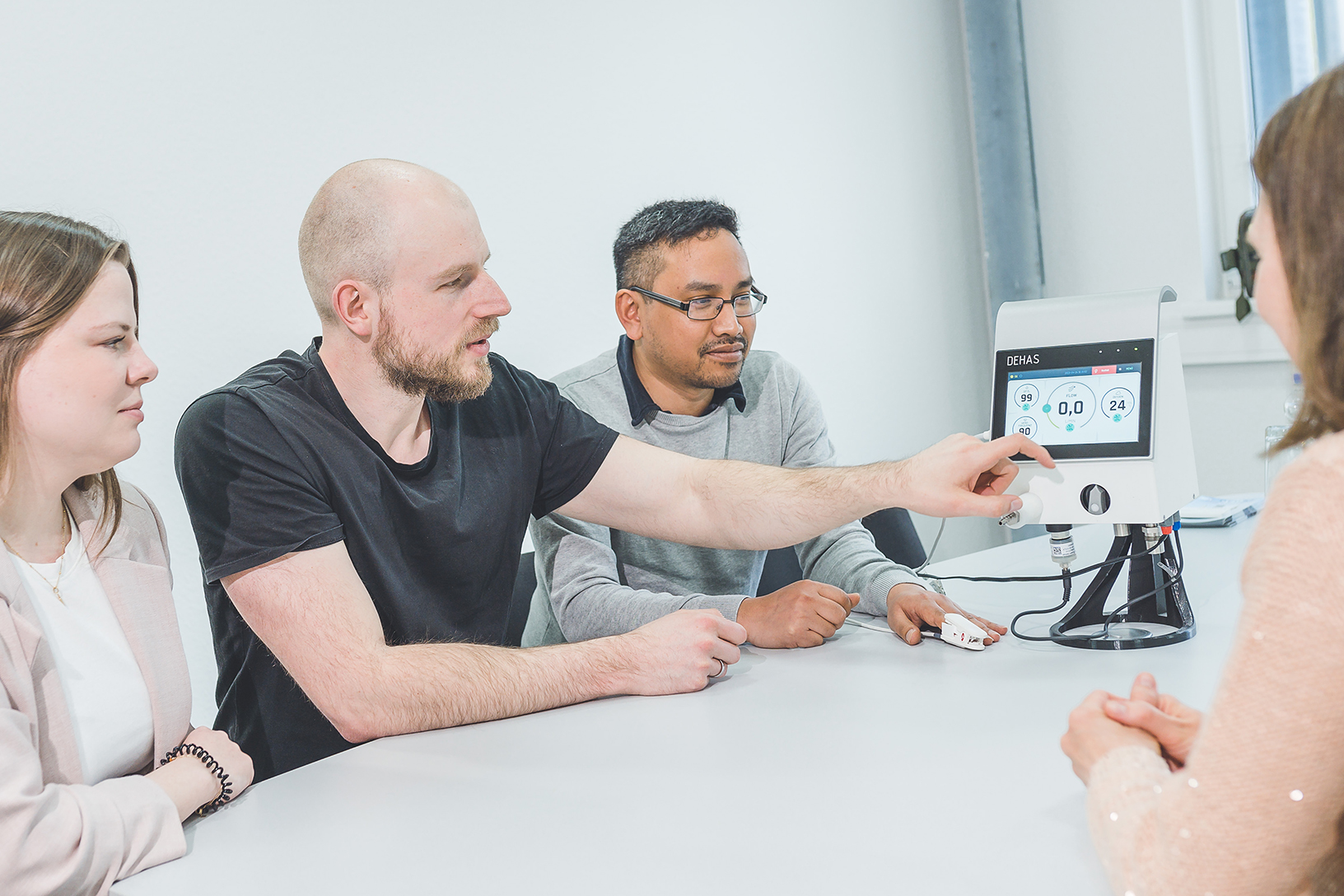
The latest generation of our air and oxygen blender, the QualityMix Pro, is an electronically controlled gas mixer with touchscreen operation without a flow meter. The electronics allow seamless integration into the existing hospital infrastructure. The device also allows measurement of the oxygen content and blood oxygen values (SpO2, perfusion index and pulse rate).
But it’s not just about oxygen as a medicine, because oxygen is often also a carrier gas. For example, our N2O mixers are used to administer nitrous oxide while maintaining a vital minimum oxygen concentration. Our QualityMix N2O-70 delivers the maximum concentration of nitrous oxide with 70% N2O and 30% O2. We also offer models with 0-50% N2O and a fixed mixing ratio of 50% N2O (QualityMix N2O 50 and QualityMix N2O 50-FIX).
In laboratories, a fixed mixture of oxygen and CO2 is often required as a non-reactive gas. We offer the QualityMix CO2 for this purpose. The device is adjusted to a fixed mixing ratio according to customer requirements.
The question of which gases can be mixed together depends heavily on the intended use and safety aspects. In general, many gases can be mixed in different ratios to meet specific requirements, such as in medicine, science, industry or diving. Here are some examples of gas mixtures:
When mixing gases, it is important to consider the chemical properties and possible reactions of the gases involved. Some gases can cause dangerous reactions when mixed, especially those that act as oxidizers (such as oxygen) or fuels (such as hydrogen). Safety regulations and professional handling are essential when mixing gases to avoid risks such as toxicity, explosion hazards or unwanted chemical reactions.
No problem – simply contact us using the telephone number or e-mail address below. Alternatively, you can also use our callback form and we will contact you by telephone.
You are currently viewing a placeholder content from Vimeo. To access the actual content, click the button below. Please note that doing so will share data with third-party providers.
More InformationYou are currently viewing a placeholder content from YouTube. To access the actual content, click the button below. Please note that doing so will share data with third-party providers.
More InformationYou need to load content from reCAPTCHA to submit the form. Please note that doing so will share data with third-party providers.
More InformationYou are currently viewing a placeholder content from Google Maps. To access the actual content, click the button below. Please note that doing so will share data with third-party providers.
More InformationYou are currently viewing a placeholder content from Google Maps. To access the actual content, click the button below. Please note that doing so will share data with third-party providers.
More InformationYou are currently viewing a placeholder content from Mapbox. To access the actual content, click the button below. Please note that doing so will share data with third-party providers.
More InformationYou are currently viewing a placeholder content from OpenStreetMap. To access the actual content, click the button below. Please note that doing so will share data with third-party providers.
More Information